
The first wireless podcast microphone—Maono PD200W Review
At first glance, you might think, “Who needs something like this?” But when you take a closer look at the Maono PD200W wireless large-diaphragm microphone, it becomes clear why such a product has been launched on the market.
You are currently viewing a placeholder content from YouTube. To access the actual content, click the button below. Please note that doing so will share data with third-party providers.
More Information-
 by
Fabian
by
Fabian
- last edited: 05.03.2026
Our Rating:
★★★★☆
The sound quality is really good for this price range when using a cable connection. The sound quality does not deteriorate significantly when using wireless.
★★★★★
The connectivity is groundbreaking in itself, as there is almost no competition: USB, wireless, and XLR in one microphone. The Maono Link software is fine.
★★★★☆
The workmanship is acceptable for this price range. It has a plastic housing and does not appear to be of particularly high quality. The tripod base itself is of high quality.
- Use our affiliate links and support our work.
Our website is free of advertising banners and we state transparently when we have been sent a product. By purchasing from our affiliate partners you do not pay more and support us. Thank you!
Maono PD200W: First impressions and contents of delivery
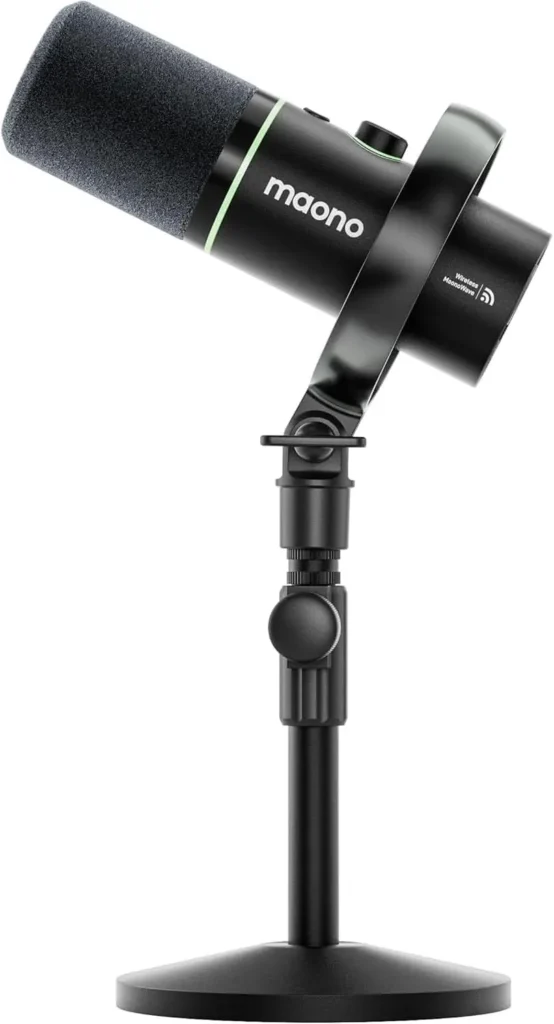
The first impression is quite exciting for a large-diaphragm microphone. In addition to a USB-C cable with adapters, a small wireless dongle with a USB-C connection is also included. You plug this into your PC, Mac, or smartphone, and the microphone connects automatically. It actually works in the same way as classic wireless microphones for content creators.
You can get started and start recording right away. It’s easy to use and the build quality is fine. It’s just an inexpensive plastic product. The included microphone stand in the form of a table stand is not made of plastic but is of fairly high quality. It’s really sturdy and won’t tip over. The package also includes a USB-C to USB-A adapter for connecting the wireless dongle to older devices without a USB-C port.
Technical features and details
Connection options: USB, XLR, and 2.4 GHz wireless
Design: Dynamic
Polar pattern: Cardioid
Bit rate: 24-bit
Sample rate: 48 kHz
Additional features directly on the microphone:
– Mute button directly on the microphone
– RGB status display
– Headphone jack for monitoring
– Integrated noise reduction
– Battery for wireless operation
The big advantage is, of course, flexibility. You can use the microphone normally via USB, connect it to an audio interface via XLR, or record completely wirelessly. This is particularly interesting for streamers or creators who change their setup frequently.
Sound of the Maono PD200W: It can do it!
Let’s get to the most important point. The sound is actually surprisingly good for the price. It is a dynamic microphone with a cardioid pickup pattern. This suppresses background noise relatively well. As is typical for dynamic microphones, the sound is slightly warmer and less sensitive than with condenser microphones. It’s just right for speech, streaming, and podcasting. It doesn’t sound quite as clear in the high frequencies and boosts the bass a little.
Sound character:
– Relatively warm sound
– Good speech intelligibility
– Little room presence
– Background noise is well reduced
The microphone is comparable in sound to the Shure MV6 or the Shure MV7 Plus, although it doesn’t quite match their quality. In particular, the details and inherent noise are worse with the Maono. However, this is clearly due to the price. In wireless mode, there are hardly any audible differences compared to USB mode.
You don't actually need wireless? PD200X
If you don’t need the wireless feature, then definitely save your money. The Maono PD200X* is exactly the same microphone without wireless technology. Maono can currently afford to charge a whopping €60 for a wireless feature because they are the only ones offering this feature in this price segment.
There are some microphone arms that allow you to hide the cable well, and always remember: another wireless device means another device you have to charge. (And which will annoy you when it runs out of power again).
Or, if you don’t need XLR and are looking for a cheaper microphone with an optional wireless feature, the Maono PD100W* might be for you.
The Maono Link recording software
Conclusion: Not absolutely necessary, but nice to have!
The Maono PD200W currently serves a market that doesn’t really exist yet. Microphones have always had cables, and everyone is used to that. USB microphones have only recently become really popular. The next logical step is a wireless microphone, especially in the gaming segment. Next to the clean setup with a wireless gaming keyboard and wireless gaming mouse, the gaming microphone with a cable looks a bit clunky.
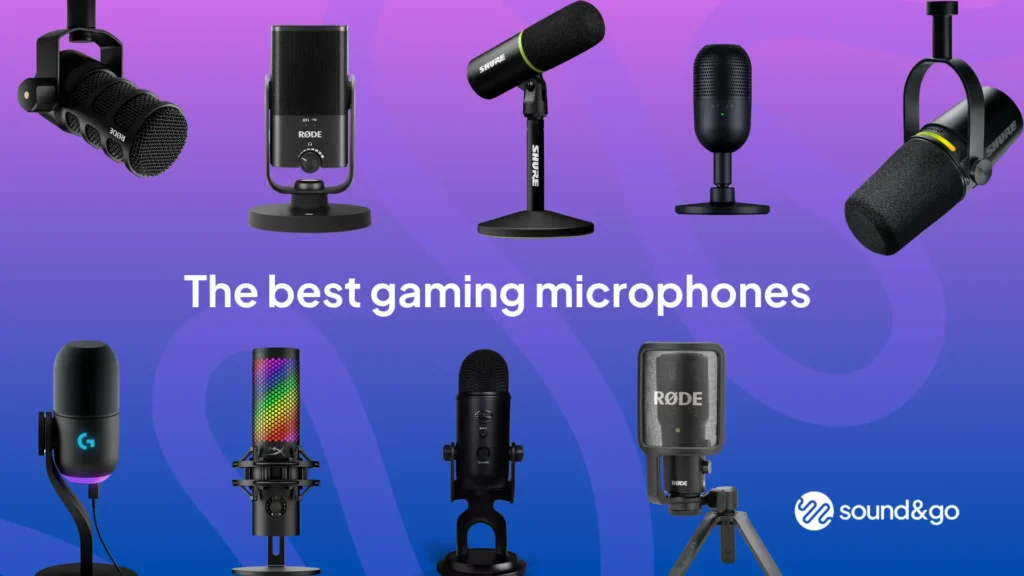
It remains to be seen how the gaming market will react to this. We wouldn’t necessarily buy it, but it is extremely versatile! Check out our comparison of gaming microphones, USB microphones, and wireless microphones.
Links marked with * are affiliate links. There are no additional costs for you, some of these links are with an automatic discount for you. We mark these links for transparency and would never recommend bad products. Find out more here: Our partners.